


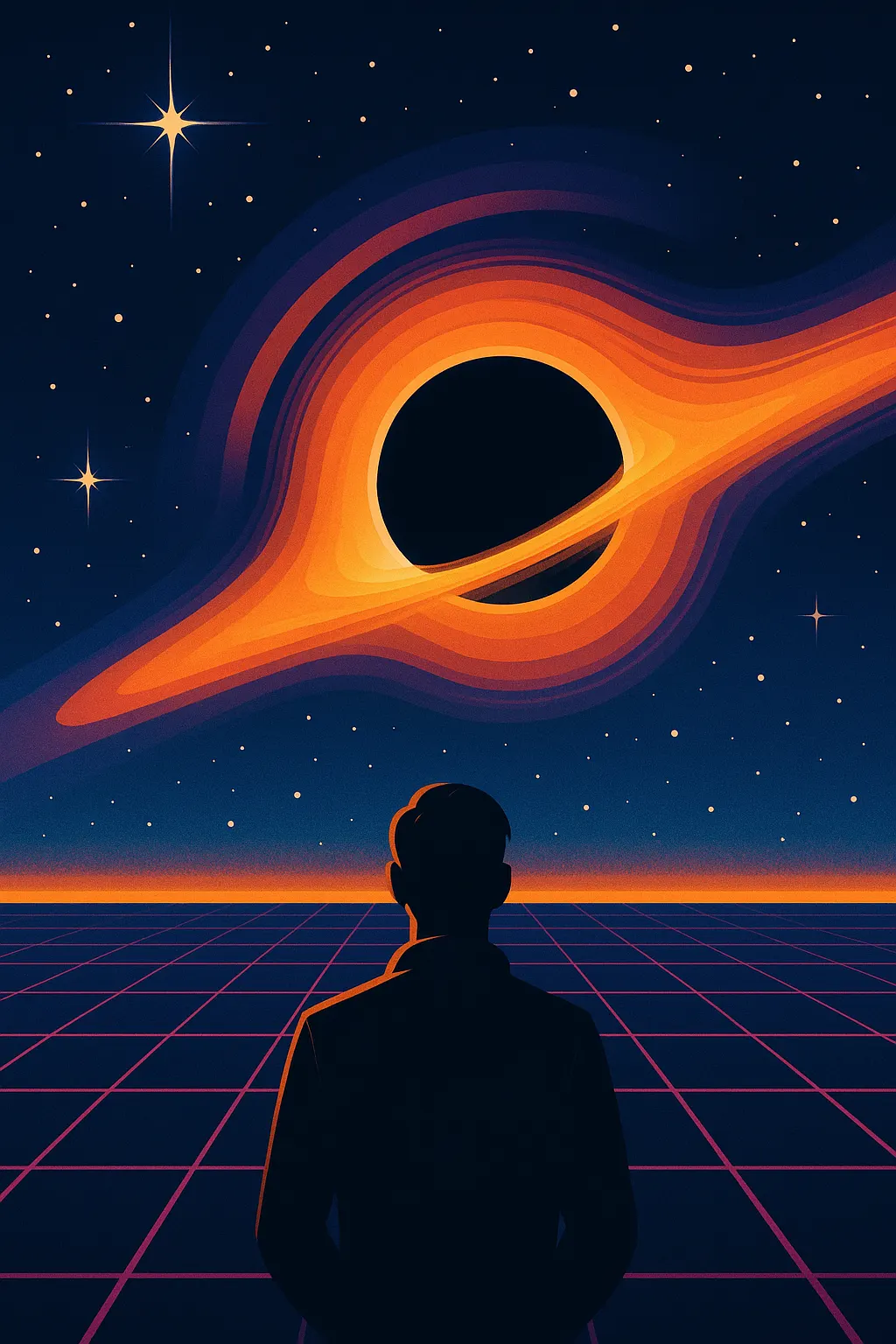
A black hole’s event horizon is the point of no return: beyond it, not even light can escape to carry information back to an outside observer. In other words, it marks a boundary between what can be observed and what cannot.
When the horizon shifts: validating Finland’s personal identity code (HETU) in Python
A concrete example is validating Finland’s personal identity code (HETU) in Python.
Early widely used chat models often produced unreliable solutions (incorrect check character logic, wrong century marker handling, missing date validation). Today, many models handle this as a matter of course and produce a correct, testable approach.
The point is not HETU itself, but the observation: a practical capability moved from “beyond the horizon” to “this side of the horizon.”
The event horizon in software development
Same idea as a slide: what is reliably usable now on the left, and what is not yet reliably achievable (or is too risky) on the right.
|
|
|
|---|---|---|
|
|
|
|
| |
|
|
What is horizon scanning?
Horizon scanning is a systematic way to track emerging capabilities (models, tools, integrations) and assess when they cross the practical benefit–risk threshold.
In practice, it means:
collecting signals (what is new),
running fast experiments (small, scoped PoCs),
evaluating (quality, safety, cost, lead time),
deciding (what to adopt, where, and under what controls
Why every software company should do this (and act on it)
AI capabilities are evolving faster than most organizations’ processes.
Without horizon scanning, a company typically either:
reacts too late (a competitor adopts the next capability first), or
adopts tools in an uncontrolled way (“shadow AI”), increasing risk.
The purpose of horizon scanning is not to predict the future. It is to keep your own event horizon up to date: recognize when a capability has become safe and useful to operationalize, and update ways of working accordingly.
Closing
The event-horizon mental model is useful because it forces clear choices: what we do now, where humans remain in the loop, and what we do not yet do. And because the horizon moves, this is not a once-a-year exercise—it is a continuous practice.