


Half a year ago, much of what's described here would have sounded utopian. Now it's everyday reality.
Plenty of services already turn a prompt into a finished application, and they work well when the application gets to be born from scratch, in its own sandbox. But for most of our customers, that isn't the question. Their digital service has to run inside their own environment: their own integrations, their own regulations, their own architectural choices. Not in empty space, but within a tightly constrained one.
The question we set out to answer was this: can such an environment be built so that the entire journey from idea to production runs agentically, and still stays inside the organization's own boundaries?
The answer is yes. We call the result aIDP, an Internal Development Platform with AI agents: an automated coding factory we build for our customers that sits fully inside their own environment, not next to it.
How aIDP works in practice
The requirement is born through conversation. The business side defines its need to its own agent. That agent doesn't operate in a vacuum; it's connected to the organization's other data sources: the design system, regulations, internal guidelines. The conversation produces a well formed requirement that both business and engineering can understand.
The requirement moves to coding agents. They turn the plan into an implementation: the code, the necessary tests, and the documentation. The same principle applies here too; the agents lean on the organization's own guidelines, not on generic assumptions about how code is "usually" written.
Review and release stay with a human. Once the implementation is ready, it gets reviewed and shipped to production with a single decision, if it's what was actually wanted. The agent proposes; the human approves. That boundary isn't a detail; it's the cornerstone of the whole model.
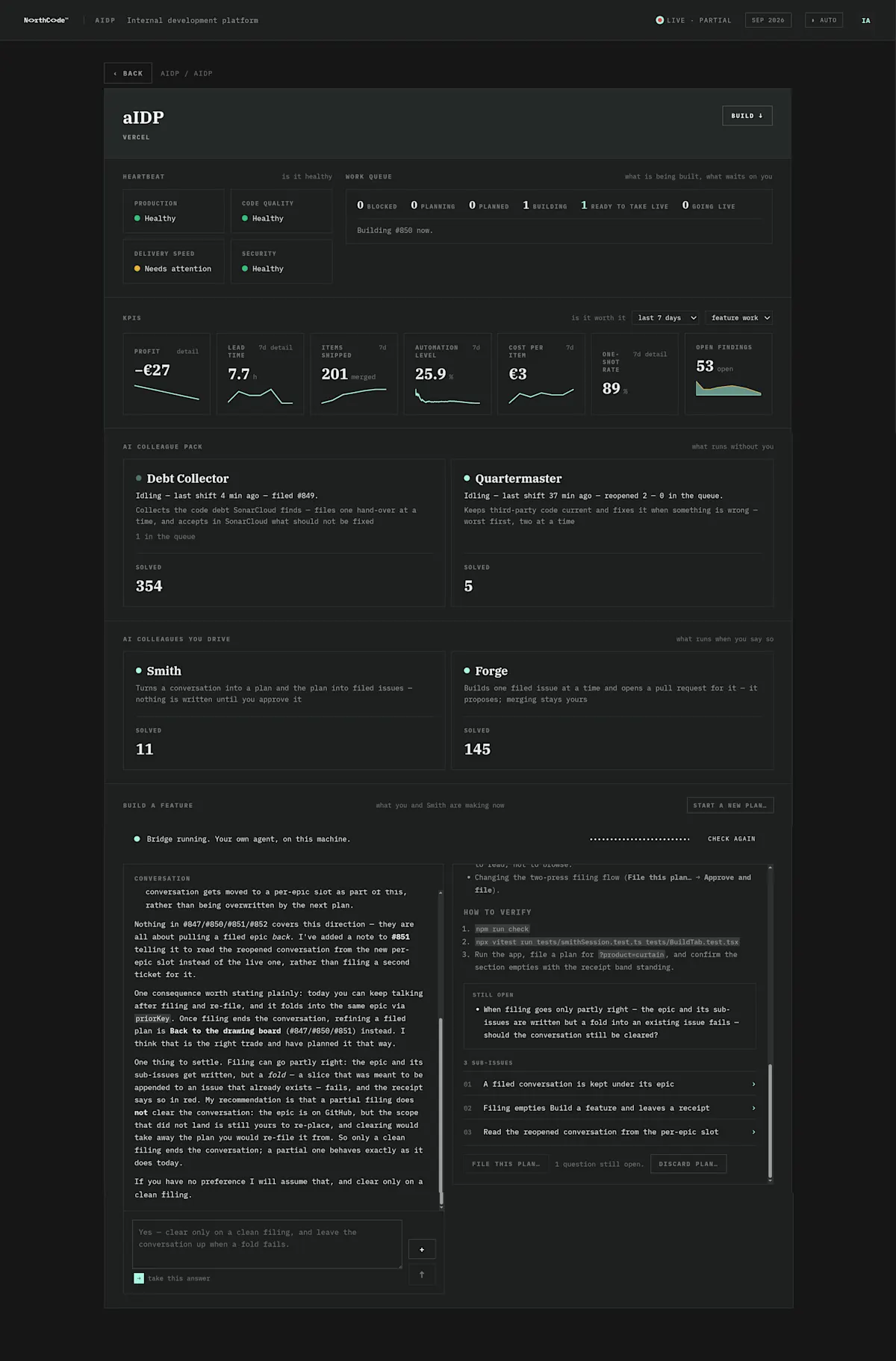
Some agents run continuously in the background. In an automated factory there are also autonomous agents that don't wait to be asked: they keep security in order and pay down technical debt as it accumulates.
Visibility isn't an add-on, it's a requirement
When a system starts to propose, fix, and build on its own, the question "is this actually healthy?" becomes more important, not less. That's why aIDP puts a real time picture of the situation at its center: is production alive, what's the code quality, are there open security findings, how fast does a change move through the pipeline. aIDP is where that picture lives, not scattered across five separate tools.
Alongside that, we track metrics that tell you whether it's all worth it: lead time, how many items shipped, automation level, cost per change, and how often an agent's first proposal is one you can accept as is.


The developer doesn't disappear from the picture, the work changes
None of the above means developers are no longer needed. Quite the opposite: once agents handle the repetitive, mechanical work (paying down debt, updating dependencies, writing the first draft), the developer's own time gets freed up for what human judgment actually decides: what gets built, why, and under what conditions it's approved for production.
Most organizations are only at the start of this journey, and it doesn't have to happen in one leap. That's exactly what aIDP is built for: a place to start deliberately, and a clear direction to grow into.
Want to hear more? You're welcome to reach out to me directly, and we'll set up a walkthrough on the topic.
Prefer to go deeper on your own first? We put what we've learned into a course.